



Arnulfo Garza Reyes, MD and Luke (Jin Kyun) Oh, MD
Bascom Palmer Eye Institute, Miami, FL
The 2026 J. Donald M. Gass Award was presented to Dr. Anita Agarwal, MD, of West Coast Retina, California Pacific Medical Center, and the Vanderbilt Eye Institute. The Retina Society established this lectureship in 2006 to honor Dr. Don Gass. Dr. Agarwal first trained with Dr. Gass at Vanderbilt and has carried forward one of his defining contributions to ophthalmology as author of the fifth and forthcoming sixth editions of Gass’ Atlas of Macular Diseases. 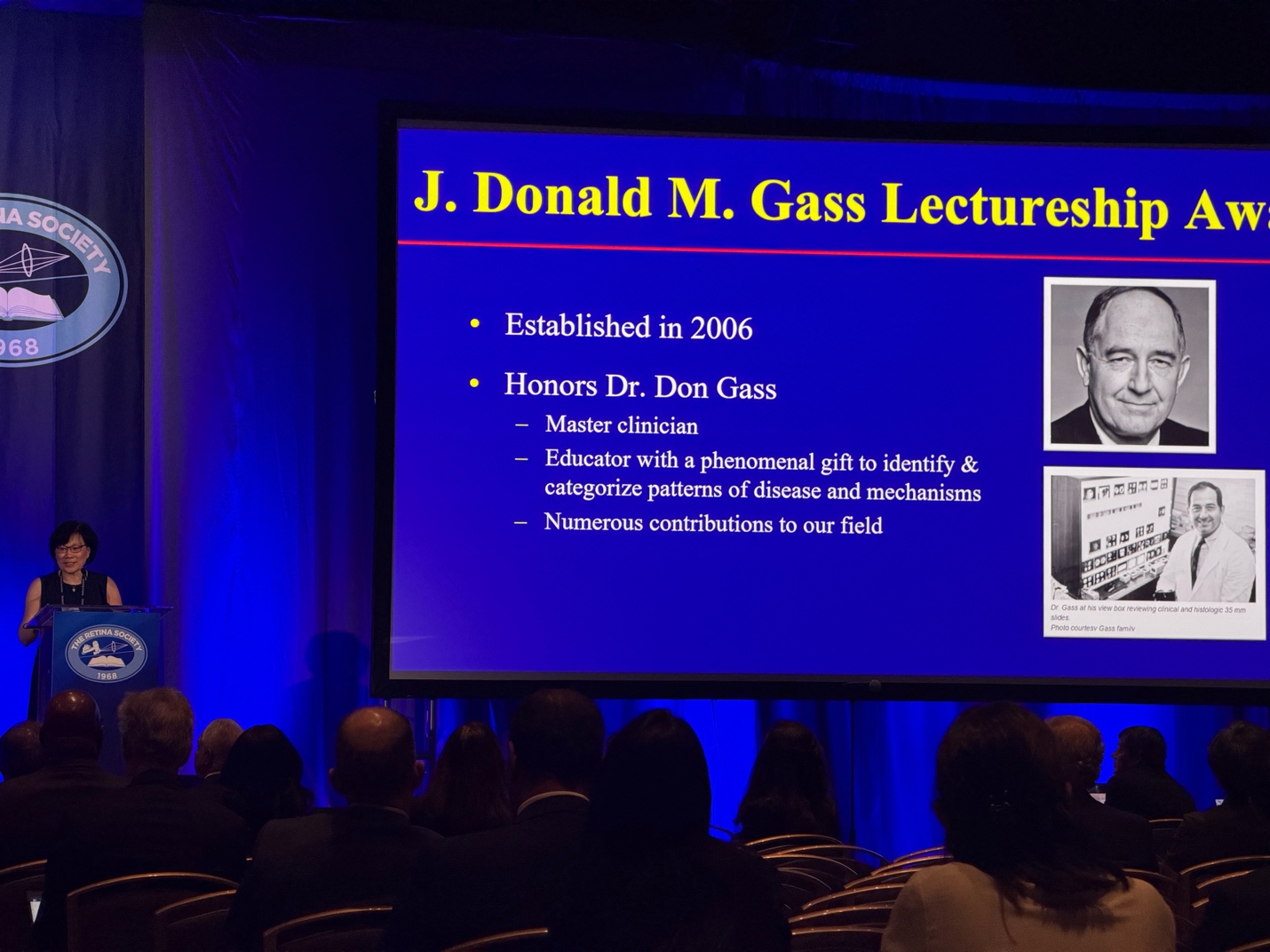

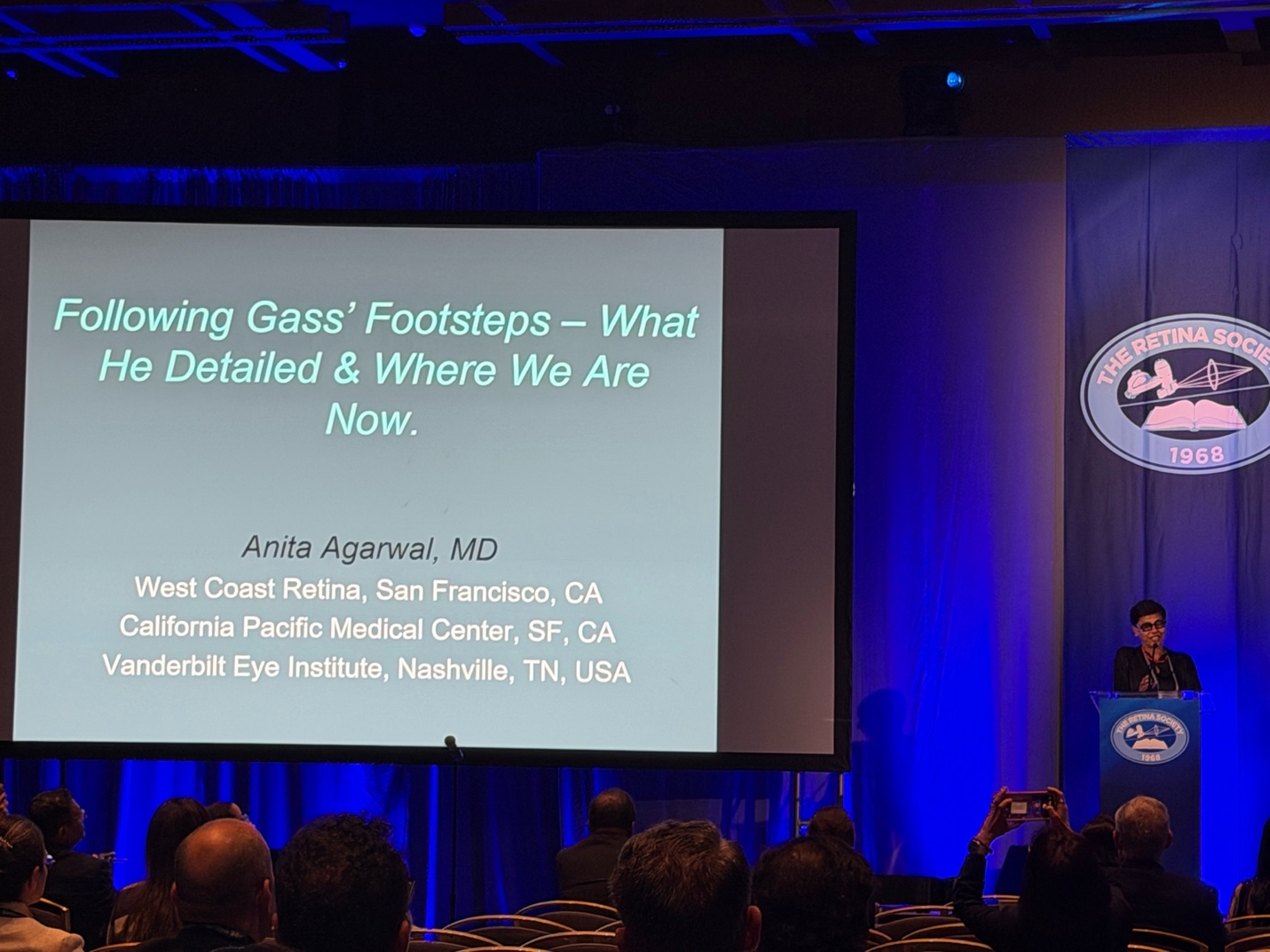
Dr. Agarwal was introduced by Dr. Jennifer Lim, MD who highlighted both her longstanding relationship with Dr. Gass and her contributions as a clinician, educator, and author. Her lecture, “Following Gass’ Footsteps – What He Detailed & Where We Are Now,” revisited several of Dr. Gass’s observations through the lens of modern imaging, genetics, and long-term follow-up. A recurring theme of Dr. Agarwal’s lecture was how remarkably well many of those observations have held up as newer technologies have allowed clinicians to see structures that Dr. Gass could previously only infer.

Beginning with AMD, Dr. Agarwal revisited Dr. Gass’s histopathologic work from the late 1960s and 1970s. He distinguished neovascularization beneath the RPE as commonly seen in AMD, from neovascularization above it as often seen in disorders such as POHS or other inflammatory disease. Dr. Agarwal then showed an example of a choroidal nevus with overlying drusen, atrophy, and choroidal neovascularization, resembling the features of AMD, over a localized area of choroidal abnormality. She interpreted this observation as support for an important role of the choriocapillaris in AMD pathogenesis. She also recalled that in his 1972 AOS thesis, Dr. Gass had already suspected a familial component to AMD. Before modern genetic testing, he would simply ask patients whether their parents had been able to read the newspaper late in life, and roughly one-quarter to one-third reported that they could not. The identification of major susceptibility loci such as CFH and ARMS2 would come decades later.
Turning to MacTel type 2, Dr. Agarwal reviewed Dr. Gass’s 1982 description and subsequent 1993 staging system before presenting her own longitudinal experience. In her series of 70 patients (139 eyes) who she followed for 4 to 14 years, visual acuity remained relatively stable in approximately 80% of eyes, while 10 eyes ultimately required treatment for subretinal neovascularization. Her discussion emphasized the role of Muller cells in the disease and the potential challenges associated with replacing them, suggesting that preservation rather than replacement may offer a more practical therapeutic approach. Invoking Sydney Brenner, she emphasized the value of working “bedside-to-bench,” allowing clinical observation to generate the questions subsequently explored in the laboratory rather than the traditional bench-to-bedside approach.
The final part of her talk addressed AZOOR, first described by Dr. Gass in 1993 in a series of 13 young adults who presented with sudden visual field loss and photopsias despite relatively subtle fundus findings. Dr. Gass had hypothesized that an infectious agent may spread silently between photoreceptors with symptoms that emerge when the host immune response was activated. Dr. Agarwal then presented her experience with 14 patients in whom OCT evidence of photoreceptor loss corresponded closely to visual field defects. Seven patients were treated with prednisone and valacyclovir, and five demonstrated improvement on both visual field testing and OCT while two of these patients required additional immunosuppression with methotrexate and mycophenolate. She also demonstrated the characteristic trizonal pattern now associated with AZOOR and noted that the same pattern can be recognized in retrospect in Gass’s original photographs.
Across these examples, Dr. Agarwal showed how modern technology has provided new ways to examine and refine Dr. Gass’s observations. OCT helped reveal outer retinal abnormalities he inferred clinically, genetics helped explain familial patterns he recognized from patient histories, and long-term follow-up extended the natural histories he noted through careful observation.
Dr. Agarwal closed with quotes from Albert Einstein and Stephen Hawking centered on curiosity as a fitting conclusion to a lecture about a physician whose discoveries so often began with noticing something others had overlooked and asking why it was there.
Congratulations, Dr. Agarwal!