



Cindy S. Zhao, MD
Stanford Byers Eye Institute, Palo Alto, CA
Moderated by Dr. Tomas S. Aleman, Dr. Jose S. Pulido, and Dr. Drew H. Scoles, the pediatric retina and retinal degenerations session this year featured five speakers covering the latest updates spanning pediatric retinal care to novel gene therapies in the pipeline.
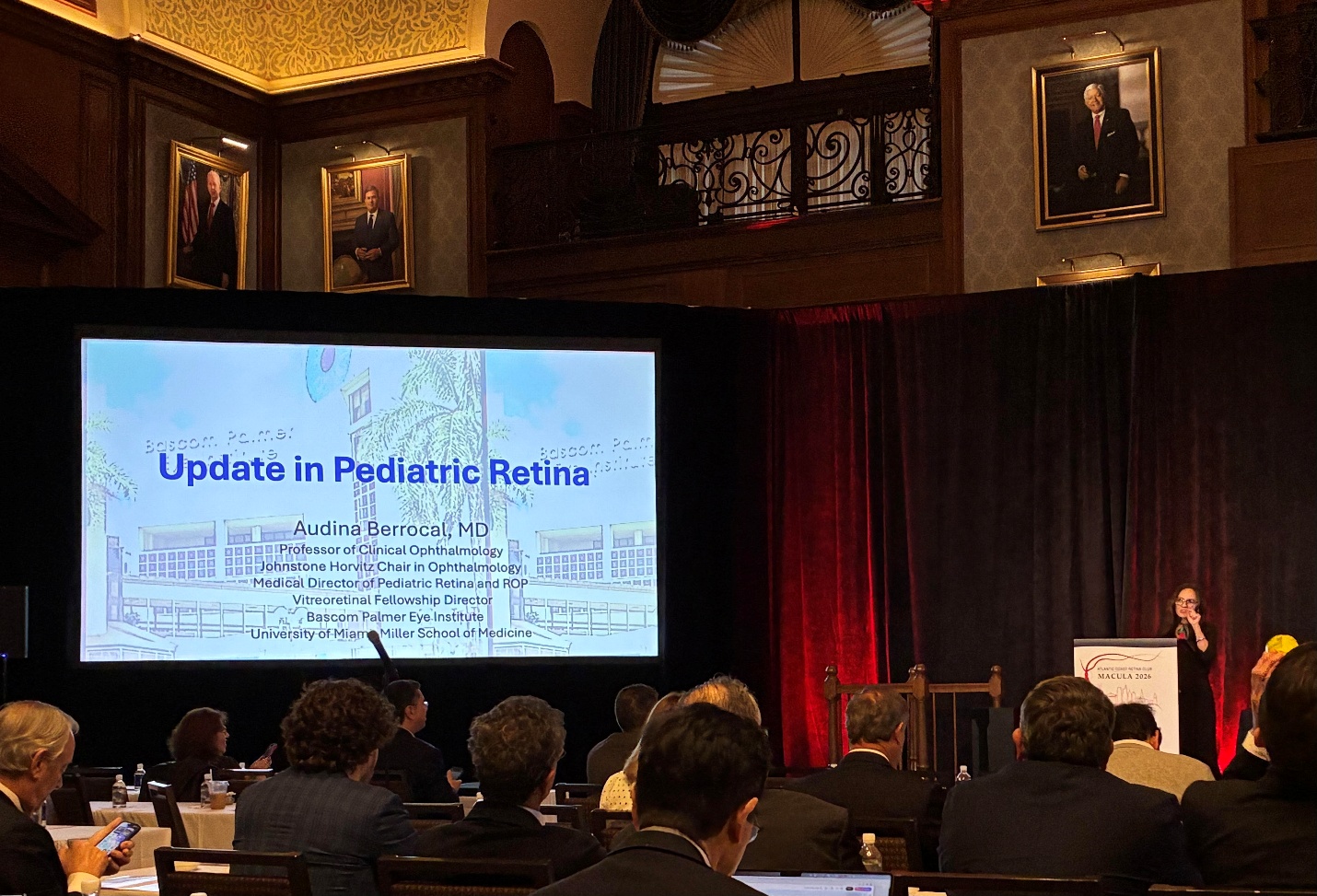

Dr. Audina M. Berrocal first presented an “Update on Pediatric Retinal Disease,” a timely presentation given her observation that differences in management principles and interest in pediatric retina have led to growing recognition of the field as a subspecialty with advanced training opportunities. She pointed out that a key goal in pediatric vitreoretinal surgery is to prevent the need for surgery in the first place and to keep the patient phakic. But when surgery is necessary, as she demonstrated through challenging Stickler and Persistent Fetal Vasculature cases, understanding the disease, careful planning, elevating the hyaloid, and removing all tractional components are critical. Here, advances in surgical instrumentation and wide field imaging have helped, and a scleral buckle can be useful. Genetic testing and gene therapy have also greatly advanced the ability to diagnose and slow visual deterioration for these patients.


Dr. R.V. Paul Chan echoed some of these thoughts in the next presentation on “Management of the Pediatric Retinal Detachment: Scleral Buckle and Digital Imaging.” Through a series of retrospective studies and clinical cases involving pediatric retinal detachments (RDs)-such as in juvenile X-linked retinoschisis, Stickler syndrome, and bilateral RDs, Dr. Chan emphasized that the scleral buckle is a valuable art that should be learned and used, with good success rates in anatomic and functional outcomes. Several aspects are different in pediatric retina, including differing anatomy with a complex vitreous, amblyopia risk, and the role of frequent imaging. Here, many exciting developments in digital imaging are transforming pediatric retinal care in the clinic and operating rooms, including some of his own work on developing a lower cost, wide-field imaging system and digital imaging that can be adapted to the smartphone.


Dr. Nicolas A. Yannuzzi continued the session with a presentation on “Optic Disc Pit Maculopathy.” This congenital anomaly has been challenging to study and manage due to heterogeneity in disease presentation and surgical management, small sample sizes, and a poor understanding of its pathogenesis and embryologic origins. Multiple complex models exist to explain how fluid might accumulate. Management options range from observation, which can result in spontaneous fluctuation and even resolution of maculopathy, to varying surgical approaches: pars plana vitrectomy (PPV) with or without internal limiting membrane (ILM) peel, macular buckle, and optic pit stuffing. Evidence supports PPV as a strategy to relieve traction and reduce the local tissue pressure gradient, while multiple large data studies suggest that ILM peel and adjunctive treatments do not confer additional benefit. To advance our ability to manage this condition, Dr. Yannuzzi proposed a registry which matches surgical outcomes with SS OCT mapping of fluid conduits.


Dr. Philip J. Ferrone transitioned the session to an update on treatment of Stargardt disease with his presentation “Gildeuretinol Slows Progression of Stargardt Disease: The TEASE Program.” Gildeuretinol reduces the toxic vitamin A dimerization that results from defective ABCA4 transport protein in Stargardt disease. While the completed TEASE-1 program focused on advanced disease and the ongoing TEASE-3 program studies early disease, Dr. Ferrone focused his talk on TEASE-2, which studied a less characterized patient population with moderate disease (photoreceptor loss without atrophy). The study population had well-balanced demographics and high retention rates but variability in EZ loss and a lack of robust natural history studies, limiting power studies. Overall in TEASE-2, gildeuretinol showed a favorable trend in reducing EZ area loss from month 6 to 24 but did not achieve statistical significance, perhaps due to insufficient power. However, in this group with moderate disease, gildeuretinol did show a significant benefit in fewer letters lost of low luminance visual acuity. Consistent with TEASE-1 and TEASE-3, gildeuretinol demonstrated a favorable safety profile with no reports of chromatopsia or delays in dark adaptation.


Finally, Dr. Stephen H. Tsang closed out the session with “Therapeutic Genome Editing in Retinal Trials.” Clustered Regularly Interspaced Short Palindropic Repeats (CRISPR) technology has become a reality in treating disease, and Dr. Tsang reviewed the ongoing trials with the three different versions of CRISPR. Most trials are still using CRISPR 1.0, which entails cut and paste technology with nucleases. CRISPR 1.0 has shown promising safety and vision improvement results in phase 1/2 of the BRILLIANCE study. CRISPR 1.0 technology is also used in ongoing phase 1/2 trials for Leber Congenital Amaurosis type 10 (LCA10) and Retinitis Pigmentosa with the RHO mutation. Most trials involving CRISPR 2.0 technology, which includes base editing, are still in phases 1 and 2. Multiple targets have been identified and are under investigation, including some with implications on retinal vascular disease such as in beta-thalassemia and sickle cell disease. CRISPR 3.0 technology allows for prime editing, with one phase 1 study targeting VEGFA in neovascular age-related macular degeneration.